Site is Loading, Please wait...
Skip to content
Resources to Optimize Athletic Performance and Sports Sciences
Adam Virgile Sports Science
  • Home
  • Courses
  • Products
  • Free Resources
    • Spreadsheets and Tutorials
    • Google Sheets 101
    • Infographics
    • Articles
  • Membership
  • Login/Register
  • 0
  • Toggle website search
0
Menu Close
  • Home
  • Courses
  • Products
  • Free Resources
    • Spreadsheets and Tutorials
    • Google Sheets 101
    • Infographics
    • Articles
  • Membership
  • Login/Register
  • 0
  • Toggle website search
You are currently viewing Comparison of velocity-based and traditional percentage-based loading methods on maximal strength and power adaptations

Comparison of velocity-based and traditional percentage-based loading methods on maximal strength and power adaptations

The referenced article can be viewed here.
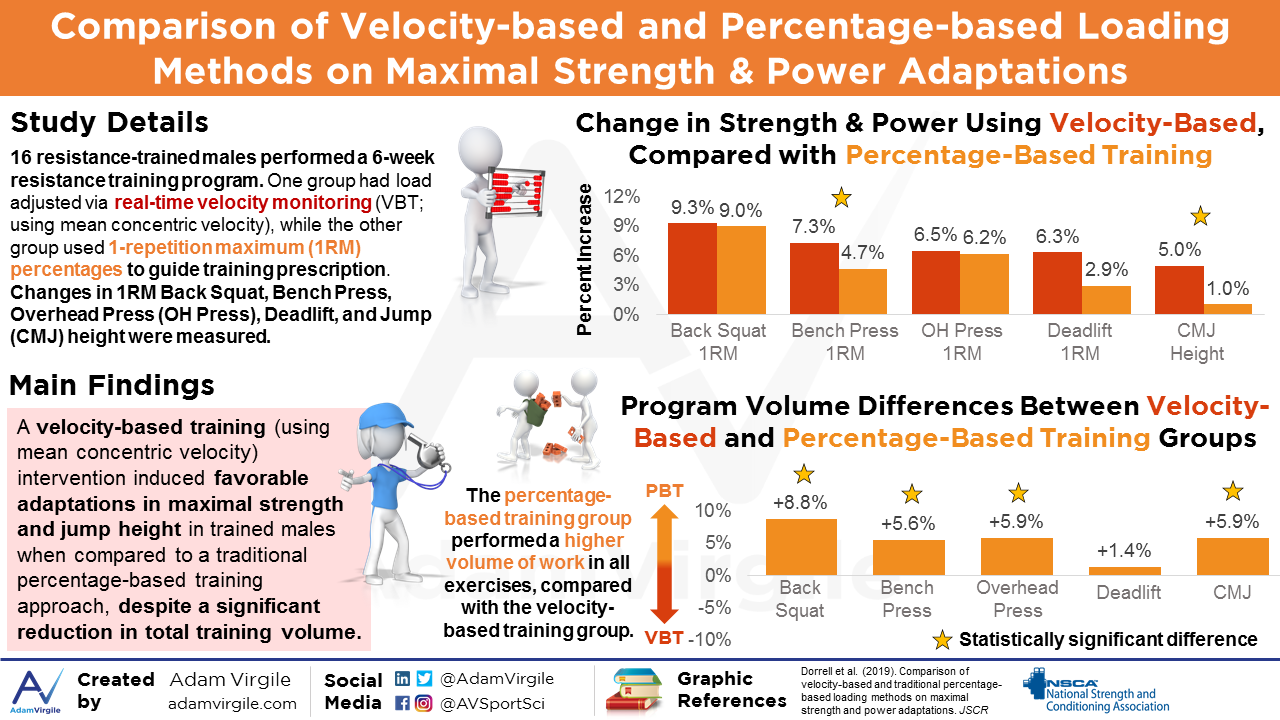
Click for Downloadable Image

Like the content? Be the first to spread the word!

  • Click to share on X (Opens in new window) X
  • Click to share on Facebook (Opens in new window) Facebook
  • Click to share on LinkedIn (Opens in new window) LinkedIn
  • Click to share on Reddit (Opens in new window) Reddit
  • Click to share on Tumblr (Opens in new window) Tumblr
  • More
  • Click to print (Opens in new window) Print
  • Click to share on Pinterest (Opens in new window) Pinterest
  • Click to share on Pocket (Opens in new window) Pocket
  • Click to share on Telegram (Opens in new window) Telegram
  • Click to share on WhatsApp (Opens in new window) WhatsApp

Read more articles

Previous PostPractical Nutritional Recovery Strategies For Elite Soccer Players When Limited Time Separates Repeated Matches
Next PostWake up and smell the coffee: caffeine supplementation and exercise performance – an umbrella review of 21 published meta-analyses

You Might Also Like

Read more about the article Assessing group-based changes in high-performance sport. Part 2: Effect sizes and embracing uncertainty through confidence intervals

Assessing group-based changes in high-performance sport. Part 2: Effect sizes and embracing uncertainty through confidence intervals

10/11/2022
Read more about the article Validity and Reliability of the Rear Foot Elevated Split Squat 5 Repetition Maximum to Determine Unilateral Leg Strength Symmetry

Validity and Reliability of the Rear Foot Elevated Split Squat 5 Repetition Maximum to Determine Unilateral Leg Strength Symmetry

09/26/2019
Read more about the article 25 Years of Session Rating of Perceived Exertion: Historical Perspective and Development

25 Years of Session Rating of Perceived Exertion: Historical Perspective and Development

02/15/2021

Search

✕
View Cart Checkout Continue Shopping
×
×

Cart