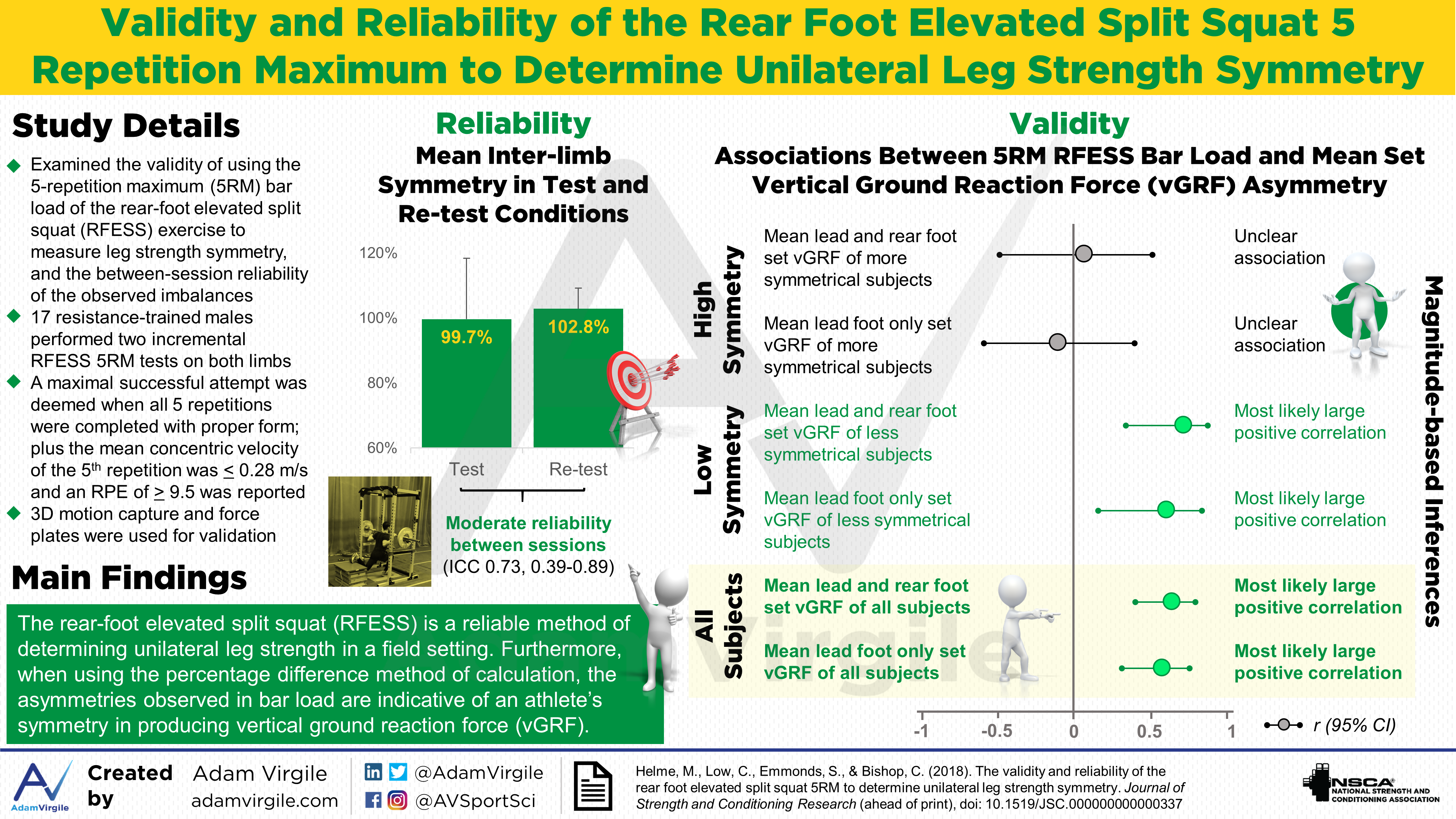
Validity and Reliability of the Rear Foot Elevated Split Squat 5 Repetition Maximum to Determine Unilateral Leg Strength Symmetry This graphic has also been published on the National Strength and Conditioning Association (NSCA) website and can be viewed here. The referenced article can be viewed here. Click for Downloadable Image Like the content? Be the first to spread the word! Share on X (Opens in new window) X Share on Facebook (Opens in new window) Facebook Share on LinkedIn (Opens in new window) LinkedIn Share on Reddit (Opens in new window) Reddit Share on Tumblr (Opens in new window) Tumblr More Print (Opens in new window) Print Share on Pinterest (Opens in new window) Pinterest Share on Telegram (Opens in new window) Telegram Share on WhatsApp (Opens in new window) WhatsApp Read more articles Previous PostWhat Dose of Caffeine to Use: Acute Effects of 3 Doses of Caffeine on Muscle Endurance and Strength Next PostStrength and Power Training in Rehabilitation: Underpinning Principles and Practical Strategies to Return Athletes to High Performance You Might Also Like Visual Feedback Attenuates Mean Concentric Barbell Velocity Loss and Improves Motivation, Competitiveness, and Perceived Workload in Male Adolescent Athletes 11/11/2019 Nutrition Strategy to Optimize Recovery After a Soccer Match 04/27/2018 Considerations for Velocity-Based Training: The Instruction to Move “As Fast As Possible” is Less Effective Than a Target Velocity 01/25/2020

Visual Feedback Attenuates Mean Concentric Barbell Velocity Loss and Improves Motivation, Competitiveness, and Perceived Workload in Male Adolescent Athletes 11/11/2019
Considerations for Velocity-Based Training: The Instruction to Move “As Fast As Possible” is Less Effective Than a Target Velocity 01/25/2020