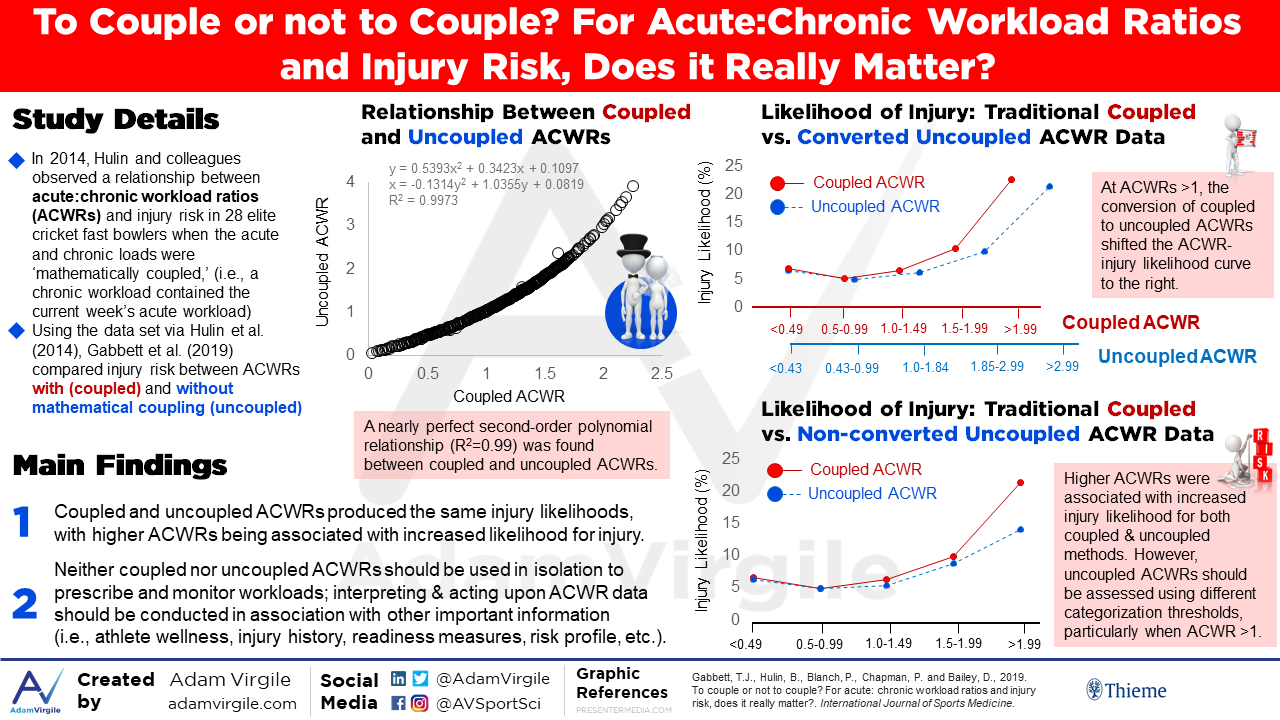
To Couple or not to Couple? For Acute:Chronic Workload Ratios and Injury Risk, Does it Really Matter? The referenced article can be viewed here. Click for Downloadable Image Like the content? Be the first to spread the word! Click to share on X (Opens in new window) X Click to share on Facebook (Opens in new window) Facebook Click to share on LinkedIn (Opens in new window) LinkedIn Click to share on Reddit (Opens in new window) Reddit Click to share on Tumblr (Opens in new window) Tumblr More Click to print (Opens in new window) Print Click to share on Pinterest (Opens in new window) Pinterest Click to share on Pocket (Opens in new window) Pocket Click to share on Telegram (Opens in new window) Telegram Click to share on WhatsApp (Opens in new window) WhatsApp Read more articles Previous PostAssociations of Context-specific Sitting Time with Markers of Cardiometabolic Risk in Australian Adults Next PostVertical- vs. Horizontal-Oriented Drop Jump Training: Chronic Effects on Explosive Performances of Elite Handball Players You Might Also Like The Association Between the Acute:Chronic Workload Ratio and Injury and its Application in Team Sports: A Systematic Review 11/25/2019 Relationship Between Pretraining Subjective Wellness Measures, Player Load, and Rating-of-Perceived-Exertion Training Load in American College Football 11/12/2019 Principal Component Analysis of the Biomechanical Factors Associated With Performance During Cutting 02/21/2022
The Association Between the Acute:Chronic Workload Ratio and Injury and its Application in Team Sports: A Systematic Review 11/25/2019
Relationship Between Pretraining Subjective Wellness Measures, Player Load, and Rating-of-Perceived-Exertion Training Load in American College Football 11/12/2019
Principal Component Analysis of the Biomechanical Factors Associated With Performance During Cutting 02/21/2022